How Credas Helped Finity Embed Seamless Right to Work Verification into a Unified Payroll Platform
Overview
Finity is payroll software built for UK bureaus, recruitment agencies, and umbrella companies — processing pay for over 150,000 workers every month. At the heart of its mission is a drive to replace disconnected tools and manual processes with a single, seamless platform that Finity calls “financial unity.”
As right to work verification grew in operational importance, Finity sought an identity verification partner that could integrate directly into its platform — bringing the same automation and efficiency to compliance checks that it had already delivered across the rest of the payroll process. Credas provided that solution, enabling Finity’s clients to complete identity and right to work checks within a single, connected workflow.
About Finity
Finity was built to solve a problem that payroll professionals know well: the cost, in time and resource, of managing payroll through a patchwork of disconnected systems. Disconnected tools and manual processes can consume up to 11 hours of a payroll team’s week — time that should be spent on higher-value work.
Finity’s platform brings the full payroll process together in one place, with integrations that automate key tasks and reduce reliance on manual intervention. Right to work verification is one of those tasks — a non-negotiable step for every worker, and one that Finity recognised could be part of a truly unified onboarding experience.
The Challenge
The opportunity to streamline a manual process
Prior to integrating Credas, right to work checks for Finity’s clients were carried out manually — a legitimate and workable approach, but one that came with operational overhead that sat at odds with Finity’s broader platform philosophy:
Each check required staff to step outside the payroll platform, carry out verification in a separate tool, and return to update records — a process taking two to three minutes per worker that added up quickly at scale.
Managing records across multiple systems increased the administrative burden on payroll teams, diverting time away from higher-value activity.
For a platform built around a unified payroll experience, a verification step that required switching between tools represented an opportunity to go further.
As Finity’s client base grew, the case for automating this step — and bringing it inside the platform — became increasingly clear.
Finity recognised that the right integration partner could transform right to work verification from a manual task sitting outside the platform into a seamless, automated part of the onboarding journey.
The Choice: Why Credas?
When Finity evaluated identity verification partners to integrate into its platform, Credas stood out for its combination of compliance credentials, ease of use, and technical integration capability. The decision was, in Finity’s own words, a natural one.
Key reasons for selection
DIATF certification — as one of the first certified Identity Service Providers in the UK under the UK Government Digital Identity and Attributes Framework, Credas provided independent assurance of platform integrity and compliance.
Seamless integration capability — Credas was able to embed directly into Finity’s onboarding workflow, enabling verification results to feed in real time into the Finity platform without manual intervention.
User-friendly experience — both the administrator interface and the worker-facing app were designed for straightforward adoption, minimising the need for training or support.
Automated right to work checks — workers complete checks digitally, with results recorded automatically and made available to administrators within Finity, supporting clear audit trails and regulatory compliance.
Competitive partner rates — Credas’ partner model allowed Finity to pass on meaningful cost savings to its clients, reducing the per-check cost compared to off-the-shelf arrangements.
The Solution
Verification embedded at the point of onboarding
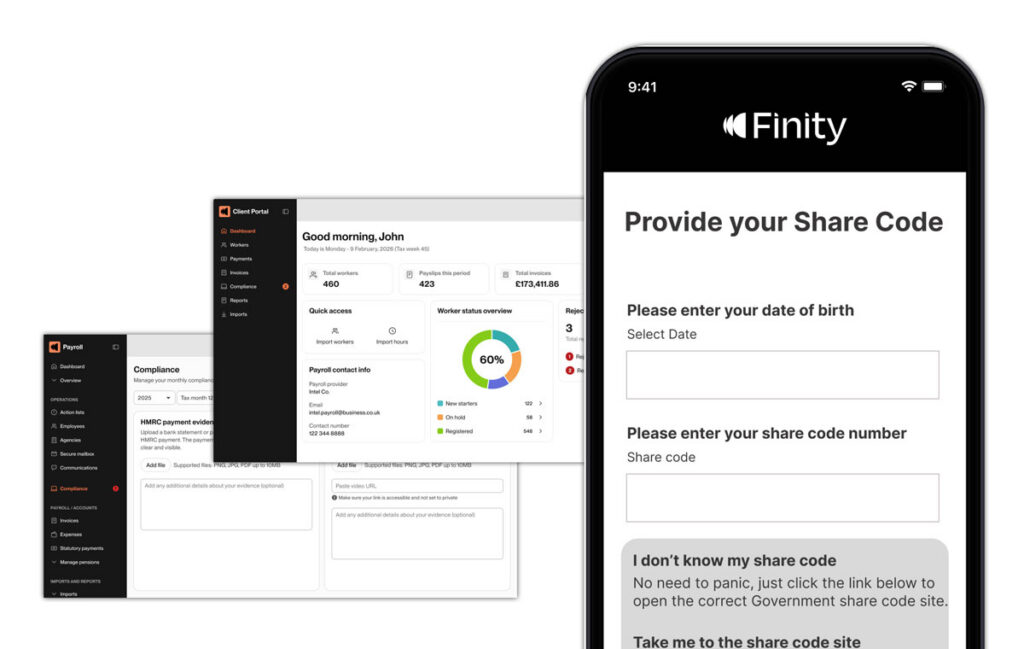
By integrating Credas directly into its platform, Finity brought right to work verification inside the payroll workflow — transforming it from a separate manual step into an automated part of the worker onboarding process. Workers are guided through identity and right to work checks digitally, completing the process independently via the Credas app. Results feed directly into Finity in real time, giving clients immediate visibility of verification status without any manual data entry or system-switching.
This integration means that a critical compliance step — one that every worker must complete — now takes place within the same platform used to manage the rest of the payroll process. The worker completes their own verification independently, freeing payroll teams to focus on higher-value activity.
A single source of truth for compliance
The Credas integration delivers three interconnected benefits within the Finity platform:
Identity verification — automated checks confirm worker identity with consistency and speed, reducing manual effort and supporting a more efficient onboarding journey.
Right to work checks — workers complete checks digitally, with results recorded automatically and made available to administrators within Finity, supporting clear audit trails and regulatory compliance.
Real-time status visibility — admins receive instant updates on verification progress directly within the platform, eliminating the need to track outcomes across separate systems.
“Partnering with Credas was a natural step for us. At Finity, we’re focused on removing friction from payroll, and identity verification is a critical part of that journey. Too often, right to work checks are manual, time-consuming, and disconnected from the core payroll process. By embedding Credas directly into Finity, we’ve transformed that experience into a seamless, automated workflow. Our clients can now save hours of admin, reduce risk, and manage compliance with confidence — all within a single platform.”
Varun Monteiro, CEO, Finity
The Results
Hours saved per cohort of workers
The efficiency gains from the Credas integration are measurable and immediate. Where right to work checks previously required staff to step outside the platform and manage the process manually, the Credas integration means the same check is completed with a single click. For a client onboarding 100 workers, that represents around five hours of administration time saved per cohort — time that payroll teams can redirect to higher-value work.
Greater consistency and clearer audit trails
Automating the verification process has brought greater consistency to how Finity’s clients manage right to work checks. Every verification is completed through the same digital process, with results captured automatically and stored within Finity alongside the rest of the worker record. For clients operating in a payroll environment where clear, auditable records matter, this provides a more robust and readily accessible evidence base — without any additional administrative effort.
A genuinely connected onboarding experience
For a platform built around the concept of financial unity, the Credas integration delivers something tangible: right to work verification that is no longer a step alongside the payroll process, but part of it. Workers complete their own checks independently via the Credas app, reducing the administrative burden on payroll teams and accelerating the time from onboarding to first payment. The result is an onboarding journey that is faster, more consistent, and more efficient — without adding friction for either clients or the workers they pay.
Cost savings passed directly to clients
Finity’s partnership with Credas has also delivered tangible commercial benefits for its clients. By operating as a Credas partner, Finity is able to offer verification checks at reduced rates compared to standalone arrangements — particularly for clients running lower right to work check volumes who would otherwise be unable to access competitive pricing. The result is a solution that saves time, reduces administrative overhead, and costs less
“”Finity is exactly the kind of partner we love working with. A team that genuinely understands the value of removing friction from their clients’ workflows. Embedding Credas directly into their platform means right to work verification happens where it should: as a natural part of the payroll process, not an afterthought. The direct, tangible benefit this delivers to payroll teams and the workers they serve is what great partnerships look like, and we couldn’t be prouder to be part of what Finity is building.”
“Finity is exactly the kind of partner we love working with. A team that genuinely understands the value of removing friction from their clients’ workflows. Embedding Credas directly into their platform means right to work verification happens where it should: as a natural part of the payroll process, not an afterthought. The direct, tangible benefit this delivers to payroll teams and the workers they serve is what great partnerships look like, and we couldn’t be prouder to be part of what Finity is building.”
Rhian Del-Valle, Director of Enterprise Partnerships
Earlier in the year, Credas joined forces with Lloyds Banking Group and Connells Group on a proof of concept built around NPTN. Rhian Del-Valle sits down with Travis Scholes from LMS to discuss why this initiative matters and what it means for consumers.
Credas are proud to partner with Anderson Strathern, a full-service law firm based predominantly in Scotland. Read our case study to see how we are working together.
When something goes wrong with a client relationship, the question compliance teams and regulators come back to is usually the same: where did the money come from?
We use cookies on our website to give you the most relevant experience by remembering your preferences and repeat visits. By clicking “Accept All”, you consent to the use of ALL the cookies. However, you may visit "Cookie Settings" to provide a controlled consent.
This website uses cookies to improve your experience while you navigate through the website. Out of these, the cookies that are categorized as necessary are stored on your browser as they are essential for the working of basic functionalities of the website. We also use third-party cookies that help us analyze and understand how you use this website. These cookies will be stored in your browser only with your consent. You also have the option to opt-out of these cookies. But opting out of some of these cookies may affect your browsing experience.
Necessary cookies are absolutely essential for the website to function properly. These cookies ensure basic functionalities and security features of the website, anonymously.
Cookie
Duration
Description
session
WordPress sets this cookie when a user interacts with emojis on a WordPress site. It helps determine if the user's browser can display emojis properly.
__cf_bm .hs-analytics.net
1 hour
This cookie, set by Cloudflare, is used to support Cloudflare Bot Management.
__cf_bm .hubspot.com
1 hour
This cookie, set by Cloudflare, is used to support Cloudflare Bot Management.
__cf_bm hs-scripts
1 hour
This cookie, set by Cloudflare, is used to support Cloudflare Bot Management.
__hssc
1 hour
HubSpot sets this cookie to keep track of sessions. This is used to determine if HubSpot should increment the session number and timestamps in the __hstc cookie. It contains the domain, viewCount (which increments with each pageview in a session), and session start timestamp.
__hssrc
session
HubSpot cookie sets this cookie to determine if the visitor has restarted their browser. If this cookie does not exist when HubSpot manages cookies, it is considered a new session.
_cfuvid
session
Calendly sets this cookie to track users across sessions to optimize user experience by maintaining session consistency and providing personalized services
afl_wc_utm_*
90
Tracks the visitors UTM parameters and click identifiers to help determine the best action to perform
cookielawinfo-checkbox-advertisement
1 year
Set by the GDPR Cookie Consent plugin, this cookie is used to record the user consent for the cookies in the "Advertisement" category .
cookielawinfo-checkbox-analytics
11 months
This cookie is set by GDPR Cookie Consent plugin. The cookie is used to store the user consent for the cookies in the category "Analytics".
cookielawinfo-checkbox-functional
11 months
The cookie is set by GDPR cookie consent to record the user consent for the cookies in the category "Functional".
cookielawinfo-checkbox-necessary
11 months
This cookie is set by GDPR Cookie Consent plugin. The cookies is used to store the user consent for the cookies in the category "Necessary".
cookielawinfo-checkbox-others
11 months
This cookie is set by GDPR Cookie Consent plugin. The cookie is used to store the user consent for the cookies in the category "Other.
cookielawinfo-checkbox-performance
11 months
This cookie is set by GDPR Cookie Consent plugin. The cookie is used to store the user consent for the cookies in the category "Performance".
CookieLawInfoConsent
1 year
Records the default button state of the corresponding category & the status of CCPA. It works only in coordination with the primary cookie.
viewed_cookie_policy
11 months
The cookie is set by the GDPR Cookie Consent plugin and is used to store whether or not user has consented to the use of cookies. It does not store any personal data.
Functional cookies help to perform certain functionalities like sharing the content of the website on social media platforms, collect feedbacks, and other third-party features.
Cookie
Duration
Description
li_gc
6 months
Linkedin set this cookie for storing visitor's consent regarding using cookies for non-essential purposes.
lidc
1 day
LinkedIn sets the lidc cookie to facilitate data center selection.
Performance cookies are used to understand and analyze the key performance indexes of the website which helps in delivering a better user experience for the visitors.
Analytical cookies are used to understand how visitors interact with the website. These cookies help provide information on metrics the number of visitors, bounce rate, traffic source, etc.
Cookie
Duration
Description
__hstc
6 months
This is the main cookie set by Hubspot, for tracking visitors. It contains the domain, initial timestamp (first visit), last timestamp (last visit), current timestamp (this visit), and session number (increments for each subsequent session).
_ga
2 years
The _ga cookie, installed by Google Analytics, calculates visitor, session and campaign data and also keeps track of site usage for the site's analytics report. The cookie stores information anonymously and assigns a randomly generated number to recognize unique visitors.
_gat_UA-77550291-23
1 minute
A variation of the _gat cookie set by Google Analytics and Google Tag Manager to allow website owners to track visitor behaviour and measure site performance. The pattern element in the name contains the unique identity number of the account or website it relates to.
_gcl_au
3 months
Provided by Google Tag Manager to experiment advertisement efficiency of websites using their services.
_gid
1 day
Installed by Google Analytics, _gid cookie stores information on how visitors use a website, while also creating an analytics report of the website's performance. Some of the data that are collected include the number of visitors, their source, and the pages they visit anonymously.
hubspotutk
6 months
HubSpot sets this cookie to keep track of the visitors to the website. This cookie is passed to HubSpot on form submission and used when deduplicating contacts.
Advertisement cookies are used to provide visitors with relevant ads and marketing campaigns. These cookies track visitors across websites and collect information to provide customized ads.
Cookie
Duration
Description
bcookie
1 year
LinkedIn sets this cookie to track the use of embedded services.
IDE
1 year 24 days
Google DoubleClick IDE cookies are used to store information about how the user uses the website to present them with relevant ads and according to the user profile.
test_cookie
15 minutes
The test_cookie is set by doubleclick.net and is used to determine if the user's browser supports cookies.